Key takeaways
- A linear supply drops the extra voltage across a transistor and turns it into heat; a switching supply turns its transistors fully on and off, which is why it can exceed 90% efficiency.
- A linear AC/DC supply needs a large mains-frequency transformer; a switching supply works at high frequency, so its transformer is a fraction of the size.
- Linear supplies still win where very low noise matters; switching supplies need filtering to keep switching noise off the output.
- On a 24 V DIN-rail unit, read the input range, output current, boost, derating with temperature and altitude, and the mounting position — not just "24 V".
- Derating can take a real bite: a 20 A unit derated at 2.5%/K above 60 °C delivers 25% less at 70 °C.
A linear power supply regulates its output by burning off the extra voltage as heat, so it is simple and quiet but inefficient and heavy. A switching (switched-mode) power supply chops the voltage at high frequency and regulates it with transistors that are either fully on or fully off, so it is far more efficient and much smaller. The 24 V DIN-rail supplies in a modern control cabinet are switching designs; the choice that matters when you replace one is which switching supply, and that comes down to a handful of lines on the datasheet.
This guide explains the difference the way a maintenance or purchasing engineer meets it, then walks through a real 24 V DIN-rail datasheet. If the label on your old unit is hard to read, start with how to find your part number.
How a linear power supply works
Monolithic Power Systems (MPS) describes the linear AC/DC supply as a simple design: a transformer reduces the mains voltage to a lower AC voltage, which is then rectified into DC and filtered. A linear regulator then holds the output constant.
That regulator is the weak point. Analog Devices explains that a linear regulator works like an electronically variable resistor in series with the input: a feedback loop adjusts it to keep the output steady, and it continuously drops the difference between input and output voltage while passing the full load current. Its example is a 5 V load drawing 10 A from a 10 V source — 50 W lost in the regulator and only 50% efficiency.
The transformer is the other limit. Because it works at mains frequency (50 or 60 Hz), MPS notes that it needs a large core to transfer real power, which makes a linear supply big and heavy and practically impossible to miniaturize. At high power, the heat the regulator has to shed also calls for very large heatsinks.
How a switching power supply works
In a switched-mode supply, MPS explains, the mains input is rectified and filtered first. A chopper then converts that DC into a high-frequency pulse train, which passes through a transformer and a second rectifier and filter to become the DC output. Because the transformer runs at high frequency, it can be a fraction of the size of the one a linear supply needs.
Regulation is done by switching, not by dropping voltage. Analog Devices points out that the transistors are used as switches that are either on or off: when on, they drop very little voltage; when off, they pass very little current; so little power is lost in either state. That is how switching converters reach efficiencies of over 90% — in the same 5 V, 10 A example, 90% efficiency means about 5.5 W of loss instead of 50 W.
Switching vs linear: the trade-offs
- Efficiency and heat. A regulated linear supply loses efficiency badly at high power; a switching supply has small switching losses and handles high power efficiently (MPS, Analog Devices).
- Size and weight. Linear needs a large mains-frequency transformer; switching uses a much smaller high-frequency one (MPS).
- Noise. Fast switching generates electrical noise that has to be filtered out. Regulated linear supplies can have extremely low noise, which MPS says is why they are used in medical sensing applications. Analog Devices adds that switching noise has declined with better control and switching schemes.
- Complexity. A linear supply has fewer components and simpler circuits; a switching supply needs filters plus control and regulation circuitry (MPS).
For a 24 V control circuit feeding PLCs, I/O, sensors, relays and valves, those trade-offs point one way: efficiency and size win. A linear supply still makes sense for a sensitive analog or measurement circuit where its low noise matters — check what the original equipment maker specified before swapping one type for the other.
Reading a 24 V DIN-rail datasheet
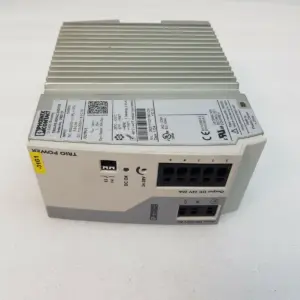
“24 V DC” on the front tells you very little. As a worked example, here is what Phoenix Contact publishes for its TRIO-PS-2G/1AC/24DC/20 (2903151), which it describes as a primary-switched power supply for DIN-rail mounting with a single-phase input and a 24 V DC / 20 A output.
- Input range. 100–240 V AC (−15% / +10%), and also 110–250 V DC. MPS notes that grid voltage differs by region (230 V / 50 Hz in Europe, 120 V / 60 Hz in North America), so check the input range against the supply in your cabinet. Note the “1AC” in the name: single-phase. Three-phase units in the same family carry “3AC”.
- Output voltage and adjustment. 24 V DC ±1%, adjustable from 24 to 28 V. Phoenix Contact notes that above 24 V the constant output capacity is restricted.
- Output current and boost. 20 A nominal, with a Dynamic Boost of 30 A for 5 seconds — Phoenix Contact positions this as 150% of nominal current to start difficult loads.
- Efficiency. Typically 91.4% at 120 V AC and 92.9% at 230 V AC.
- Hold-up. Mains buffering of typically 10 ms at 120 V AC and 15 ms at 230 V AC — how long the output survives a short input dropout.
- Ripple. Under 100 mV peak-to-peak at nominal values.
- Signals. A DC OK LED and a floating DC OK relay contact that a PLC can monitor.
- Parallel and series. Parallel connection is allowed for redundancy and increased capacity; series connection is allowed too.
Derating: temperature, altitude and mounting
Rated current is only available inside the conditions on the datasheet. For the TRIO 2903151, Phoenix Contact gives an operating range of −25 °C to 70 °C with derating of 2.5% per kelvin above 60 °C. At 70 °C that is 25% less — about 15 A from a 20 A unit. Above 2,000 m the output derates by 10% per 1,000 m, up to a maximum of 4,000 m. The specified mounting position is horizontal on a 35 mm DIN rail (NS 35, EN 60715).
So when you size a replacement, add up the 24 V loads, then check that the unit still covers them at the temperature inside your cabinet and at your site’s altitude — and that it will be mounted the way the datasheet assumes.
Replacing a DIN-rail power supply: what to match
- Read the label and part number and find the datasheet for that exact model.
- Match the input: single-phase or three-phase, and the voltage range your cabinet supplies.
- Match the output: voltage, adjustment range and nominal current — and boost, if the old unit had to start motors, valves or capacitive loads.
- Check the derating at your cabinet temperature and altitude, so the new unit covers the load in real conditions.
- Match the extras the machine uses: a DC OK contact wired to the PLC, parallel or redundant operation, and the connection type (push-in or screw).
- Check the width and mounting against the space on the rail.
You can browse what is in stock in power supplies and the wider power category. Each listing states its condition — see what those labels mean in our condition labels guide and the condition guide. If you cannot find your model, send the part number or photos of the label through Request a Part.
Frequently asked questions
Is a DIN-rail 24 V power supply switching or linear?
Check the datasheet wording. Phoenix Contact, for example, describes its TRIO 2903151 as a primary-switched power supply — a switched-mode design.
Why is a switching power supply more efficient than a linear one?
A linear regulator drops the excess voltage across a transistor and turns it into heat. A switching supply uses its transistors as on/off switches, which lose little power in either state, so efficiencies above 90% are possible (Analog Devices).
When is a linear power supply the better choice?
Where output noise matters most. MPS notes that regulated linear supplies can have extremely low noise, which is why they are used in medical sensing applications.
What does derating mean on a power supply datasheet?
It is how much output you lose outside standard conditions. The TRIO 2903151, for instance, loses 2.5% per kelvin above 60 °C and 10% per 1,000 m above 2,000 m altitude.
Can I connect two DIN-rail power supplies in parallel?
Only if the datasheet allows it. Phoenix Contact allows parallel connection of the TRIO 2903151 for redundancy and increased capacity; check the specific model before wiring units together.
What does "1AC" or "3AC" mean in a power supply name?
In Phoenix Contact's TRIO naming it marks a single-phase (1AC) or three-phase (3AC) input, as in TRIO-PS-2G/1AC/24DC/20 and TRIO-PS-2G/3AC/24DC/20.
Sources
- Analog Devices — Advantages of Switching Regulators Over Linear Regulation (technical article, 28 Sep 2018) (opens in a new tab)
- Monolithic Power Systems — Understanding AC/DC Power Supplies (opens in a new tab)
- Phoenix Contact — TRIO-PS-2G/1AC/24DC/20 (2903151) product page and technical data (opens in a new tab)
- Phoenix Contact — TRIO-PS-2G/3AC/24DC/20 (2903155) product page (opens in a new tab)