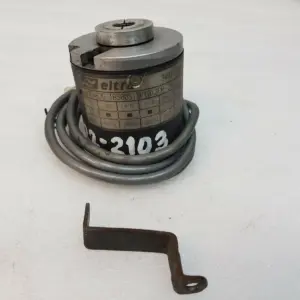
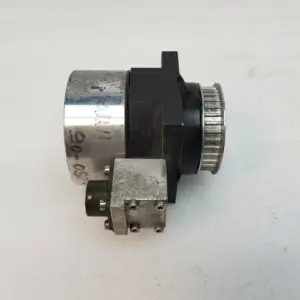
Key takeaways
- An incremental encoder outputs pulses for each change in position; an absolute encoder outputs a digital word that identifies the position itself.
- After a power loss an incremental system must be re-homed; an absolute encoder reports its position as soon as it is switched on.
- Incremental resolution is quoted in pulses per revolution (PPR); absolute resolution in bits, often split into single-turn and multi-turn.
- PPR and CPR are not used the same way by every maker — 4x counting happens in the controller, not in the encoder.
- For a like-for-like replacement, match the type, resolution, output circuit, supply voltage and interface, not just the shaft.
An incremental encoder sends a stream of pulses as the shaft turns, and the drive or PLC counts them from a home position. An absolute encoder sends a digital value that identifies the exact position, so it knows where it is the moment power comes back. That one difference decides how the machine starts up, how the encoder is wired and which replacement will work.
This guide explains both types the way a maintenance or purchasing engineer meets them: what each one outputs, what the numbers on the label mean, and what to check before ordering a replacement. If you only have a worn label, start with how to find your part number.
The short answer: pulses vs a position value
Dynapar puts it simply: an absolute encoder keeps a record of its position within an absolute coordinate system, while an incremental encoder outputs incremental changes from a pre-defined home position. Because of that, an incremental encoder needs additional electronics — typically a PLC, counter or drive — to count the pulses and turn them into speed or position. An absolute encoder produces digital words that identify the location directly.
HEIDENHAIN describes the same split as two measuring methods. In the incremental method, position is found by counting individual measuring steps from a chosen point of origin, and a reference mark is needed to establish an absolute reference. In the absolute method, the position value is read directly from the scale and is available immediately when the encoder is switched on.
How an incremental encoder works: A, B and Z
A single-channel incremental encoder gives one pulse stream. It can measure speed, but it cannot tell which way the shaft is turning. Most industrial units are dual-channel, or quadrature, designs: two outputs, A and B, that are 90° out of phase. The direction of travel decides which channel goes high first, and the controller uses that to track direction (Dynapar).
Many incremental encoders also have an index channel, usually called Z. It produces one pulse per revolution and can be used to find a specific location at startup, or to count revolutions on a fast shaft. Some designs also provide inverted signals (A-not, B-not) for differential line-driver outputs.
- A and B — the two quadrature channels; their phase order gives direction.
- Z (index) — one pulse per turn, used as a reference point.
- Inverted channels — present on differential line-driver outputs, which Dynapar notes support longer cable runs.
What happens when the power goes off
This is the practical reason to choose one type over the other. When an incremental system is powered down, it does not track any movement of the shaft, so it has to be re-homed at the next startup. For a machine that is shut down every night and homed every morning, that is not a problem. For an axis that cannot safely move to a home switch after an outage, it is (Dynapar).
An absolute encoder holds its position through a power outage and the system can resume without re-homing. HEIDENHAIN notes that because absolute encoders do not need a reference run, they suit transfer lines and machines with many axes. So a machine that runs a homing or reference sequence after every power-up is a strong hint of incremental feedback on that axis — confirm it on the encoder’s datasheet.
Single-turn and multi-turn absolute encoders
A single-turn absolute encoder gives a unique value for every position within one revolution, and the value repeats on the next turn. A multi-turn encoder also counts complete revolutions, so each position over the whole travel has its own code (Dynapar). Dynapar recommends single-turn for motion under one turn, and multi-turn where the total number of rotations matters or where re-homing after power loss would be costly.
Multi-turn encoders count turns in different ways: a gear train driving secondary code discs, a Wiegand-wire pulse that powers an internal counter without gears, or a battery that keeps the count while main power is off. Dynapar points out that with a battery-backed design, if the shaft moves while power is off, the system may still need re-homing unless the counter inside the encoder is itself battery-backed. On a replacement, check which method the original uses.
Resolution: PPR, CPR and bits
Incremental resolution is usually given in pulses per revolution (PPR). Quadrature lets the controller count every rising and falling edge of A and B, which can raise resolution by up to four times. Dynapar stresses that the encoder itself does not output four times the pulses: a 120 PPR encoder still gives 120 cycles per revolution, and the multiplication happens in the controller.
The abbreviations are not used consistently. US Digital, for example, uses PPR for the count after 4x quadrature and CPR for the count before it, and notes that other vendors use the same terms with different definitions. When you compare an old encoder with a replacement, compare the maker’s datasheet definitions, not just the number.
Absolute resolution is given in bits. Each track on the code disc adds one bit, so n tracks give 2n positions. Dynapar notes that many makers start at 12 bits (4,096 positions per turn) single-turn, with advanced devices reaching 22 bits. A multi-turn encoder adds bits for the revolution count — Dynapar’s example is 12 bits single-turn plus 12 bits multi-turn, described as a 24-bit encoder.
Outputs and interfaces: what must match
Incremental encoders send square-wave signals through an output circuit that has to suit the input it connects to. Dynapar’s FAQ lists the common ones: open collector (an NPN transistor that needs an external supply and load), push-pull (its output follows the supply voltage), totem pole (5 V only) and the differential line driver. HEIDENHAIN lists TTL square-wave signals to RS-422, typically 5 V, and HTL signals, typically 10 V to 30 V.
Absolute encoders send their position over a data interface. Dynapar lists BiSS, SSI, DeviceNet, PROFIBUS, Modbus, CANopen, IO-Link and Ethernet-based protocols; HEIDENHAIN’s brochure also covers EnDat and drive makers’ own serial interfaces. Some absolute interfaces carry incremental signals as well, so a cable with A/B pairs does not by itself prove the encoder is incremental.
How to tell which one you have
- Read the label and part number. A figure in PPR or pulses points to an incremental encoder. A resolution in bits, “ST/MT”, or an interface name such as SSI, BiSS, EnDat, PROFIBUS or CANopen points to an absolute one.
- Look up the datasheet for that exact part number and note the resolution, output circuit, supply voltage, shaft or bore and connector.
- Check the machine. An axis that homes after every power-up is a hint of incremental feedback; the datasheet confirms it.
- Note the output and supply — push-pull, open collector or line driver, and 5 V or 10–30 V — and the receiving input on the drive or counter.
- Match mechanics last: solid or hollow shaft, diameter, flange and connector or cable.
If the label is gone, send us photos of the encoder, its connector and the machine plate through Request a Part. You can browse what is in stock in encoders and the wider motors & motion category, and check what each listing’s condition means in our condition guide.
Frequently asked questions
What is the main difference between an absolute and an incremental encoder?
An incremental encoder outputs pulses that a controller counts from a home position. An absolute encoder outputs a digital value for the position itself, so it knows its position at switch-on without homing.
Which is better, absolute or incremental?
Neither in general. Dynapar describes incremental encoders as simpler and generally lower cost, suited to speed and simpler positioning; absolute encoders suit axes that cannot afford re-homing after a power loss.
Does an incremental encoder lose its position when power is off?
Yes. It does not track movement while powered down, so the system has to re-home at startup, often using the Z (index) pulse or a home switch.
Is a 1024 PPR encoder the same as 4096 counts?
The encoder still outputs 1024 cycles per channel per turn. A controller using 4x quadrature decoding can count 4096 edges per turn, but makers define PPR and CPR differently, so check the datasheet.
What does 12-bit or 24-bit mean on an absolute encoder?
It is the number of position values: 12 bits is 4,096 positions per turn. On multi-turn encoders the total often combines single-turn bits with bits that count revolutions.
Can I replace an incremental encoder with an absolute one?
Only if the drive or controller supports the absolute encoder's interface and is configured for it. The wiring, signals and setup are different, so check the drive manual first.
Sources
- Dynapar — Incremental & Absolute Encoders: What's the Best Solution for Your Application? (white paper) (opens in a new tab)
- Dynapar — Encoder FAQs (opens in a new tab)
- Dynapar — Single-Turn vs Multi-Turn Encoders (opens in a new tab)
- HEIDENHAIN — Interfaces of HEIDENHAIN Encoders (brochure 1078628) (opens in a new tab)
- US Digital — Glossary: Pulses Per Revolution (opens in a new tab)